
Why Genshin Impact's Patch 4.8 Fairy Tale Tease Still Defines Storytelling in 2026
The Genshin Impact 4.8 fairy tale teaser signaled a permanent narrative shift, weaving meta-commentary on authorship into the game's deepest lore.
As a professional Genshin Impact player with thousands of hours logged, I've learned that the moments developers choose to be blunt about narrative stakes are the moments we should pay the closest attention. Even now, deep into 2026, the official teaser for Patch 4.8 stands as one of the most revealing narrative signposts the game has ever dropped. The artwork, the wording, the sheer audacity of placing the "author" front and center — everything about that preview screamed that we were about to witness something far bigger than a temporary summer event. Looking back, that fairy tale teaser didn't just advertise a patch; it permanently rewired how I approach Genshin's storytelling.
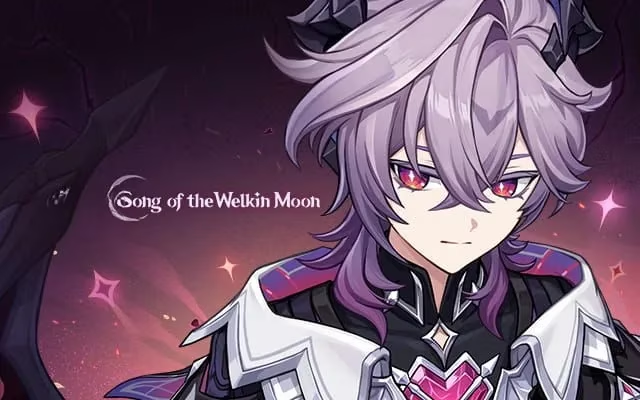
When the 4.8 teaser landed, seasoned Travelers immediately recognized it as a chapter finale flex. Genshin rarely broadcasts its narrative intent so nakedly. The devs traditionally wrap lore bombs in cheerful melodies and beachside minigames, but here they framed everything around the protagonist advancing a fairy tale toward its long-awaited ending. The language was unmistakable: an author writing the beginning, middle, and end. That framing instantly recalled arcs like "We Will Be Reunited" in 1.4 and Sumeru's Act VI in 3.2, where player agency collided head-on with scripted fate. For those of us who live in the lore channels, the message was clear — hoard your Primogems, revisit Mondstadt's oldest unsolved riddles, and brace for a permanent shift in the world's narrative rules.
📖 The Meta-Commentary That Changed Everything
What made the 4.8 preview uniquely powerful was its self-aware posture. By introducing the concepts of an "author" and "imagination" alongside the Traveler, the teaser transformed the fairy tale into a commentary on storytelling itself. This "story about stories" approach didn't come from nowhere. Veterans will remember the Golden Apple Archipelago reruns (1.6, 2.8), where we were both actors and observers of unfolding fables. The Sumeru arc (3.0–3.2) then pushed the theme further by making us confront the possibility that our own journey might be someone else's script. Patch 4.8 picked up that baton and ran with it, turning a seemingly whimsical event into a meditation on authorship, destiny, and the unpredictable role of the player.
Even the visual design hammered this home. The stylized book, the vivid pink script, the dreamy color palette — it was all a direct invocation of Alice and the Hexenzirkel witches. Characters like Klee, whose storybook whimsy has always felt like a ticking narrative bomb, suddenly seemed to stand at the center of something monumental. For lore-focused players, the implication was electric: the fairy tale wasn't just a side story; it might be the connective tissue directly linking Fontaine's conclusion to whatever region awaited us next.
🎮 Preparing for the Unknown: A Pro Player's Resource Guide
From a gameplay perspective, a trailer this loaded with narrative promise forced immediate resource recalibration. Official materials back then didn't reveal banner specifics, which is standard for HoYoverse — they let the story tease do the heavy lifting while beta data trickles out. But history gave us a roadmap. Temporary event regions in Genshin almost always pair with exclusive currencies, special domains, and atypical team compositions. Patch 2.8 had Echoing Conches; 3.8 gave us the Veluriyam Mirage. A pattern like that means only one thing for free-to-play and low-spending travelers: stockpile resin, artifact fodder, and region-specific materials before the patch even drops.
I also advised a roster check focused on versatility. Narrative domains frequently enforce "bonded" elemental effects or forced character deployment scenarios. Off-field Hydro applicators, sturdy shielders, and single-target burst specialists tend to shine when the devs design encounters around story-driven mechanics. The community buzzed with speculation about Durin or the mysterious witch becoming playable or returning as a boss — unconfirmed, naturally — which only reinforced the need for flexible teams. In my experience, preparing a universal squad that includes a shielder, a healer, and an off-fielder from at least three different elements covers 90% of these surprise narrative challenges.
Reward expectations also stayed grounded. Standard patch event payouts — Primogems, a Crown of Insight, enhancement ores — are almost guaranteed, but event-exclusive weapons or companion gadgets are the real treasures. I always tell my followers: monitor the official livestream like a hawk, because those 10–14 days pre-patch are when drip marketing confirms or shatters every banner dream.
🧩 Community Reactions and the Hexenzirkel Thread
In the days following the teaser, every major Discord server and subreddit I frequented was on fire. Theorycrafters dissected the author-versus-protagonist dichotomy with the energy usually reserved for Archon Quest finales. Many interpreted it as a continuation of themes first seeded way back in the Unreconciled Stars event, where the sky itself seemed to be a storybook page. Connections to "storybook endings" tied directly to Alice, the Hexenzirkel, and the unresolved mystery of what those witches truly want. The pink script in the teaser image felt like a direct signature, a calling card that promised answers — or at least meaningful questions — about Mondstadt's hidden layers.
For me, the teaser resurrected a long-standing fascination with Durin and the idea that corrupted dragons might be victims of larger narratives. Articles on EarlyGG covering Mondstadt through Durin's eyes and speculation about a playable Durin circulated heavily, feeding the theory that 4.8 would do more than conclude a fairy tale; it might alter how we perceive past calamities. The language of a "long-awaited ending" could as easily apply to the Traveler's arc, the fate of an ancient dragon, or the Witch's hidden agenda. That ambiguity is Genshin at its best.
🌟 What 2026 Owes to That Teaser
Now, in 2026, I see the 4.8 teaser as the blueprint for every subsequent narrative gamble the developers have taken. The willingness to frame events around authorship and imagination has become a recurring device, popping up in world quests and limited events alike. We've since seen the Hexenzirkel's influence creep deeper into new regions, confirming that the mysterious "storybook" wasn't just a one-off motif. Players who took the 4.8 message to heart — who held onto their Primogems, revisited Mondstadt's hidden corners, and treated every fairy tale reference as potential canon — were rewarded with deeper contextual understanding when later patches dropped their own meta-narrative twists.
My advice for travelers in 2026 remains rooted in what that teaser taught me. When the official channels start whispering about authors, endings, and imagination, treat it not as flavor text but as a tactical briefing. Review your inventory, pad your flexible team slots, and follow official Genshin Impact channels on YouTube, Twitter, Facebook, TikTok, and HoYoLAB for the earliest whiffs of banner confirmations. Resources like EarlyGG's coverage of speculative articles — from "Durin Playable in Genshin 4.8?" to "Mondstadt Through Durin's Eyes: A New Lore Perspective" and "Genshin Impact Mystery Witch Gifts" — remain essential reading for separating fact from fervent hope.
The fairy tale ending promised in 4.8 may now be history, but the lessons it planted continue to bloom. Genshin Impact's story is never just a story; it's a conversation between author and player, and the 4.8 teaser was the moment that conversation stopped whispering and started shouting. If you're preparing for the next big update, ask yourself: have you checked the library for unread books lately? Because the next fairy tale might already be writing itself.
This perspective is supported by Game Developer (formerly Gamasutra), and it helps frame Genshin’s 4.8 “author versus protagonist” tease as a deliberate narrative-design move rather than mere event flavor—reinforcing how limited-time arcs can function like tightly scoped story experiments that later echo into mainline quest structure and player expectation management.